My Message close
GAME JOBS
Latest Blogs
spacer View All     Post     RSS spacer
 
May 22, 2013
 
Using Small Studios As Stepping Stones In Your Career [1]
 
How Can You Find Jobs At Blizzard if You're an Artist?
 
Let’s produce HTML5 games with a serious approach.
 
An Object Of Lust [1]
 
Gamasutra Blog Guidelines - Updated and open for discussion [13]
spacer
Latest Jobs
spacer View All     Post a Job     RSS spacer
 
May 22, 2013
 
Wargaming.net
UI Scripter - AS3
 
NetherRealm Studios
Lead Software Engineer
 
Monolith Productions
Lead Mission Designer
 
Insomniac Games
Sr Network Programmer
 
Insomniac Games
Gameplay Programmer
 
Insomniac Games
Concept Artist- Environment
spacer
Latest Press Releases
spacer View All     RSS spacer
 
May 22, 2013
 
GAME confirms pre-orders
for Xbox One
 
EA ANNOUNCES BATTLEFIELD
4 FOR XBOX ONE AND...
 
Microsoft unveils Xbox
One: the ultimate
all-in...
 
NEW EA SPORTS IGNITE
ENGINE TO POWER EA
SPORTS...
 
Crytek’s
CryENGINE® 3 Already
Primed for...
spacer
About
spacer Editor-In-Chief:
Kris Graft
Blog Director:
Christian Nutt
Senior Contributing Editor:
Brandon Sheffield
News Editors:
Mike Rose, Kris Ligman
Editors-At-Large:
Leigh Alexander, Chris Morris
Advertising:
Jennifer Sulik
Recruitment:
Gina Gross
Education:
Gillian Crowley
 
Contact Gamasutra
 
Report a Problem
 
Submit News
 
Comment Guidelines
Sponsor

 
Interview: I Am Robot Makes Game
Interview: I Am Robot Makes Game Exclusive
 

April 21, 2009   |   By Jeriaska

Comments 1 comments

More: Console/PC, Exclusive


[In this game music interview, Jeriaska catches up with Toronto's I Am Robot And Proud, who talks -- at least obliquely -- about his collaboration on Everyday Shooter creator Jon Mak's new game, plus his particular brand of electronic music.]

Toronto-based musician Shaw-Han Liem creates electronic music under the heading "I Am Robot and Proud." Following the release of his most recent album he performed in clubs in Tokyo, Fukuoka, Kyoto, Nagoya and Osaka for his Uphill City tour.

While away from the stage, he was participating in the creation of his first game project, a collaboration with Jonathan Mak, the designer of Everyday Shooter.

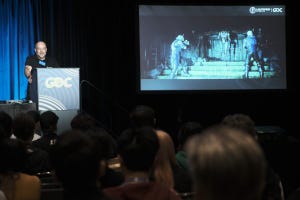
Previously, Shaw-Han has designed both electronic visual media and sounds for his live performances. The subject of this discussion, coinciding with the artist's live show as part of the 10-Bit Party at the Game Developers Conference, is his entrance into the world of videogame music and the background details behind his recent progress on his first game score.
In addition, the conversation offers a perspective on how visual design and the intersection between technology and artistic expression has inspired I Am Robot and Proud.


In talking about your first experience creating the soundtrack to a videogame, what was it about the project as it was initially described that appealed to you as a musician?

Shaw-Han Liem: Jon and I had actually been in university together, and been friends for a while before we started "officially" working together on this project. The first time I played Everyday Shooter, Jon brought a laptop and headphones to a show I was playing at a club in Toronto. He set it up in an alley and people started crowding around. I think the two of us have similar interests in exploring art, music and technology, and that was the basis for our collaboration.

Were there elements of Everyday Shooter that were reflective of your approach to I Am Robot and Proud?

While I think we share meta-level "vision", our approaches are actually quite different. Jon produces his visuals and music using code as the primary instrument -- randomness is a big part of the fun of his method.

I think my own process is more like collage, deliberately layering things on top of each other to create a larger whole. For me the idea of giving up control to randomness is a bit scary, so the challenge for us was to merge these two approaches in a way that emphasizes what is fun about each of them.

Do you find there are aspects of living in Canada that may have influenced you both, in terms of your artistic outlooks and creative methods?

We both grew up around Toronto, actually a few streets away from each other. I think the great thing about Toronto is that it is a big city, but also feels like a small town in a lot of ways.

In a larger city with tons of stuff going on, the "game people" and the "music people" might operate in their own separate worlds, but in Toronto, everyone is kind of in the same boat, since it's fairly small. There is all this cross-pollination happening because everyone kind of knows everyone else, and everyone is trying to reach out to whomever is doing something interesting. Toronto has pretty good food too, which is important for hungry programmers late at night.

There is an interactive musical component to your website that I'm sure a lot of people comment on. When did you decide to add the musical houses and stars to robotandproud.com?

I made that little flash header around the time of my third album, which would have been 2002/2003.


Would it be reading too much into this image to see it as an illustration of the title "I am Robot," the way the child's head glows in time with the music, while he's plugging cables into an electronic keyboard?

I think there is a loose connection there, but definitely not something that I was consciously thinking about when I made it. I guess the name of the record "The Electricity in Your House Wants to Sing" kind of encapsulates the message - that machines are an extension of the human imagination.

Has it crossed your mind during the making of your albums that your music might suit a soundtrack, whether for a movie or a game?


It was never really something I thought about much in the past -- although I followed games a bit, and watch movies, obviously, I never really saw anything in either of those realms that I felt suited my musical style or approach.

It is only very recently that I've started to think about how to combine what I'm doing musically with people working in other creative fields. I did a tour in Japan in 2006, and a good friend of mine (musician 6955, also working on the game 'Fez') introduced me to some of the more off-the-radar game scene stuff in Tokyo.

That was when I was introduced to things like Rez, Electroplankton, and Tenori-on. It seemed like there was a lot of interesting ground to be covered in terms of games and music.

So I suppose what I'm doing now is the beginning of this experiment. The album "Uphill City" was recorded last year while I was working concurrently on fleshing out some of the game ideas with Jon. Also, I've started programming my own visuals for my live show and doing odd jobs for TV commercial music and such. I'm slowly exploring these ideas about combining music, visuals and interactivity.

When I picked up your new album at Tower Records in Tokyo, there was a bonus CD featuring a vocal track, which was surprising considering your albums since the 2002 release of You Make Me This Happy have been primarily electronic and nonvocal, the kind of music that would easily suit any number of video games as background tracks.

The song you probably got was a collaboration with a friend Heidi Hazelton, who is a friend and musician here in Toronto.

It's fun for me to work with vocalists, and I've done things like remixing and collaborations in the past. I also play more "traditional" music with bands and such - but I think there is a certain universal quality to instrumental music that appeals to me. I think there is a kind of freedom there and also gives more room for the listener to interpret the music on their own.


You have had the chance to spend some time in Japan recently. Has the gaming industry as you observed it there at all influenced the visual element that you bring to your live performances?

This year around the time of Tokyo Game Show, Jon and I spent a month in Japan. I was touring for my last album and Jon was there to work on the game.

We had a place to stay near Akihabara, but actually I was touring around to various parts of the country for a lot of the time. I think we both took a lot of inspiration from that trip - not specifically Akihabara or the game scene, but from the city in general. It was just a good change of scenery for both of us.

Actually, when Jon and I originally started collaborating, it wasn't to work on a game, it was to work on my visuals. He has a lot of interest in computer-generated geometric art -- he has a lot of interest in visual design, but his primary tool is computer code. I had been doing simple experiments in the 'processing' environment, but working with him I've learned a lot of different approaches to designing visuals with code.

Will you be contributing to the visual style of the game?

The game and visual design are Jon's work -- my contributions are in the music and designing some of the interactions (as they relate to the musicality).

Prior to publishing the album "The Catch" in 2002, did you struggle much with establishing a personal musical style?

I think every musician or artist goes about this differently, but for for me it has been a very organic process. I was playing in a lot of punk bands in my teenage years, but also studying computers. I started listening to electronic music and became interested in using the computer as a composition tool. I spent a lot of years just working on stuff in my basement, experimenting with all kinds of software and listening to all kinds of music.

Over the years I've incorporated a lot of things and been influenced by a lot of fellow musicians both in my home city of Toronto and also through touring and meeting people around the world. It's an ongoing process, and that is what makes it interesting - seeing something great (whether it is another musician, a piece of visual art, a crazy snowfall, a game) and finding new ways to think about your own music.

Your music is not characterized as "traditional", but has it been deemed out of the ordinary at times?

There are probably people who would think of music like mine as out of the ordinary, but I don't really look at it that way. I think it's natural for music to reflect the times and technology.

So, for example, if you look at a saxophone today, it looks like a totally weird and alien piece of technology - a giant hunk of metal with valves and levers everywhere, but then you look at the technology from that time - a steam engine, for example - and you can see the connection. Someone took the technology of that time and figured out how to make music with it.

I think the same kind of thing has happened with computers - they were basically created as number crunching machines but people have thought of ways to make them sing. To me, that is the really exciting part about electronic music right now. There is so much interest in finding new ways of using computer hardware and software to create new tools and new music.

[The album Uphill City is available on Amazon and iTunes. Studio photo courtesy of I Am Robot and Proud. GDC photo by Jeriaska. Samples from the album can be heard on robot+proud.com]
 
 
Top Stories

image
Xbox One is Microsoft's biggest move for living room domination
image
Opinion: Xbox One is a desperate prayer to stop time
image
Unity's mobile licenses are now free
image
Xbox One isn't always-on, but it will require a regular connection


Comments

Taure Anthony
profile image
awesome Im looking forward to this


none
 
Comment:


UBM Tech